
Everyday health · 27 November 2026
Mumbai winter haze: reading the AQI, protecting your lungs
For Mumbai families who've noticed the grey winter mornings and want to know what to check and what to change.
Quick read
The whole note in about a minute.
- The idea: Winter haze is air holding more fine particles than usual, and the AQI sorts it into six plain categories.
- Read it: CPCB's scale runs from Good to Severe, and Moderate already means breathing discomfort for people with lung, asthma and heart conditions.
- Try this: On Poor, Very Poor or Severe days, skip the outdoor morning and late evening walk or run.
- Protect: A well-fitted N95 or N99 mask helps, while paper masks, scarves and cloth don't.
- When to see a doctor: Consult a doctor for breathlessness, giddiness, cough, chest discomfort or pain, or red, watery eyes.
What is the haze over Mumbai in winter?
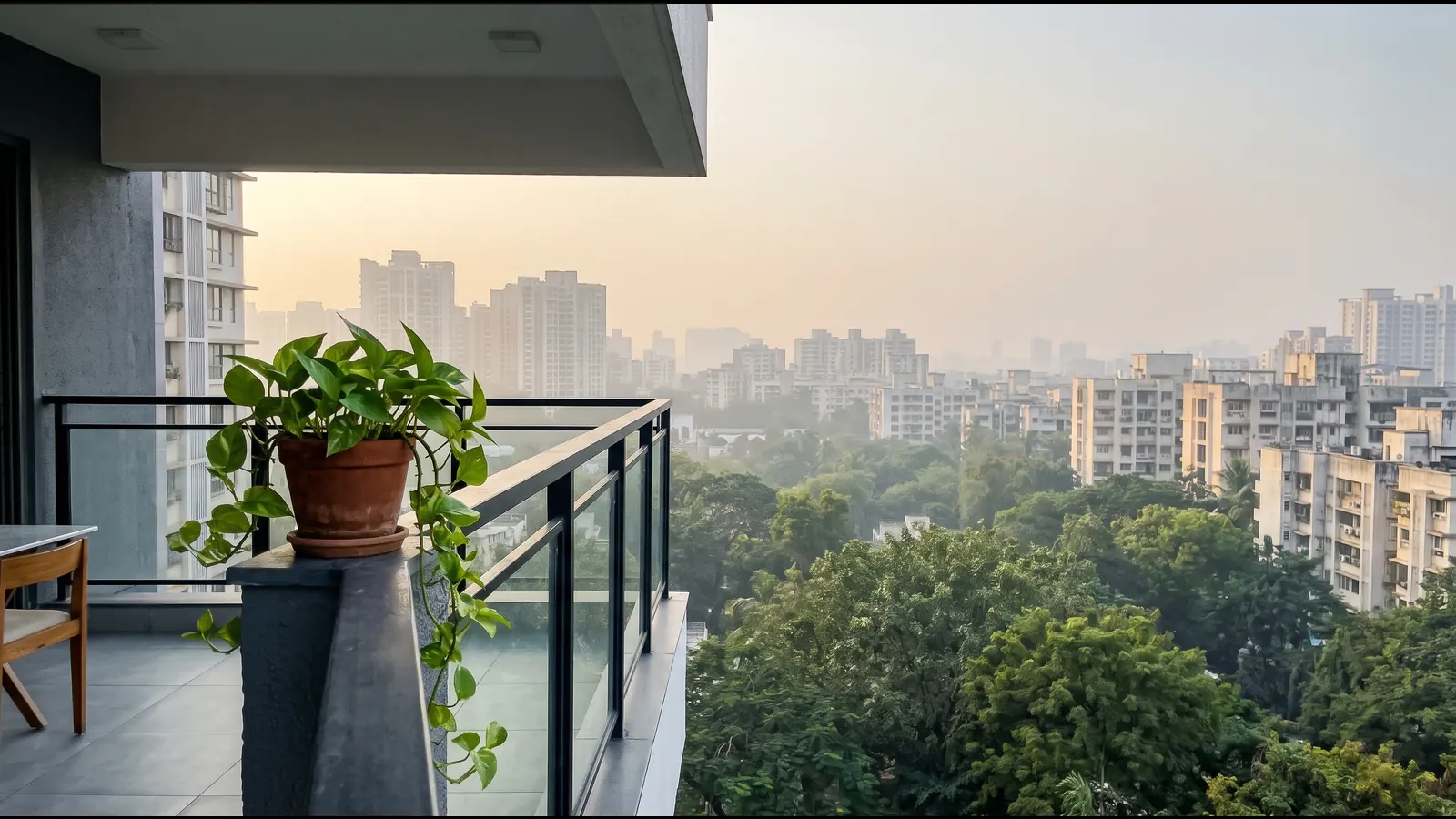
It's air carrying more fine particles than usual. On some winter mornings the view from a high-rise turns soft and grey. The health ministry's advisory calls the smoke-and-fog mix "SMOG (Smoke + Fog)".
The particles come from everyday sources. NPCCHH's handbook for ASHA workers lists construction work, factory smoke, diesel generators and vehicle exhaust. Indoors, the handbook adds burning plastic waste, tobacco smoke and mosquito coils. Weather matters too. The advisory says wind, temperature, rain and other weather factors "play a key role" in how clean the air is.
You'll see two names: PM2.5 and PM10. They're particles far smaller than a human hair. The WHO says fine PM2.5 particles "penetrate deep into lung passageways".
How do I read the AQI?
The Air Quality Index (AQI) turns pollution readings into one number. India's Central Pollution Control Board (CPCB) uses six categories, with this health note beside each:
- Good (0 to 50): minimal impact.
- Satisfactory (51 to 100): minor breathing discomfort to sensitive people.
- Moderate (101 to 200): breathing discomfort to people with lungs, asthma and heart diseases.
- Poor (201 to 300): breathing discomfort to most people on prolonged exposure.
- Very Poor (301 to 400): respiratory illness on prolonged exposure.
- Severe (401 to 500): affects healthy people and seriously impacts those with existing diseases.
Readings change by the day and from one monitoring station to the next, so check the one closest to your area.
Check the AQI on the CPCB website or the Sameer app. Forecasts are on mausam.imd.gov.in.
Should I change my morning walk?
It depends on the category. On Good days, the advisory lists no special precautions. At Satisfactory, only vulnerable people are asked to limit prolonged or strenuous exertion. At Moderate, everyone is asked to limit strenuous outdoor exertion, and vulnerable people to avoid it.
On Poor to Severe days the advice is plainer: "avoid outdoor morning and late evening walk, run, jog and physical exercise." At Very Poor, everyone is asked to avoid outdoor activities, especially in the morning and late evening. At Severe, vulnerable people should remain indoors and keep activity low. You can still move. If you're stuck indoors, our note on sitting less has ideas that fit a flat.
Does a mask help?
Yes, the right one does. The advisory says a disposable N95 or N99 is useful when user instructions are followed. The enclosure adds that it's most useful for short exposures. The ASHA handbook adds that it should fit closely.
Paper masks, handkerchiefs, scarves and cloth are not effective. A dupatta over the nose feels like protection, but the advisory says it isn't.
What about the air inside my flat?
Indoor air counts, since you spend most of the day there. On Poor-and-above days, the advisory suggests ventilating between 12 p.m. and 4 p.m. Keep windows and doors closed in the morning and late evening.
It also suggests wet mopping instead of sweeping. Skip mosquito coils, incense and room fresheners. If you cook, keep the kitchen cross-ventilated. Avoid any air purifier that makes ozone. In an air conditioner, use the "re-circulate" mode.
What you can do
- Look at today's AQI before you plan the walk, run or children's playtime.
- On Poor days or worse, move exercise indoors or skip it.
- Keep an N95 or N99 mask for short, unavoidable trips on bad days, and fit it snugly.
- Wet-mop instead of sweeping, and leave mosquito coils and incense out of closed rooms.
- Open windows from 12 p.m. to 4 p.m. on bad days, not in the early morning or late evening.
Who feels it first?
The advisory lists older adults, children under 5, pregnant women and people with pre-existing illnesses such as asthma as more vulnerable. People who work outdoors, such as traffic police and construction workers, are also at higher risk.
With a heart or lung condition, the advisory suggests keeping prescribed medicines handy and following your doctor's instructions. It also says to seek advice quickly if symptoms worsen. On Poor-and-above days, it asks schools to limit outdoor activity for children.
When should I see a doctor?
The advisory says to consult the nearest doctor for breathlessness, giddiness, cough, chest discomfort or pain, or red or watery eyes. If symptoms worsen, seek medical advice immediately.
Common myths
A scarf or dupatta over the nose works like a mask.
The advisory says paper masks, handkerchiefs, scarves and cloth are not effective. A well-fitted N95 or N99 is the one it names.
If the sky looks clear, the air is clean.
The advisory describes the harmful pollutants as smaller than the human eye can detect, so the AQI is a better guide than the view.
Questions people ask
Where do I check today's AQI?
On the CPCB website or the Sameer app. Forecasts are at ews.tropmet.res.in and mausam.imd.gov.in.
Can I run my AC on a hazy day?
Yes. The advisory suggests the "re-circulate" mode in air conditioners and vehicles.
Should I buy an air purifier?
The advisory only gives one rule: avoid any purifier that works by generating ozone, because it increases pollution inside rooms.
Can children play outside in winter?
On Good or Satisfactory days there's no special limit for most children. On Poor-and-above days, the advisory asks schools to limit outdoor activity.
Make the AQI part of the morning routine, like checking the weather, and let the category decide the walk.
Neulife Labs is a neighbourhood pathology lab in Jogeshwari West, with home sample collection in nearby areas.
Related: Sitting all day: how to move more without finding extra time · Helping older parents avoid falls at home
Sources: Advisory on Air Pollution and Health, NCDC and NPCCHH, Ministry of Health and Family Welfare; Air Pollution Health Advisory (Enclosure), NCDC and NPCCHH; Handbook for ASHA: Air Pollution and Its Impact on Health, NPCCHH; Ambient Air Pollution: Health Risks, World Health Organization.